Why the Block Universe Gives Life Its True Power — and Radical Presentism Leaves It Powerless
Twenty-five years ago, Eckhart Tolle gave the world The Power of Now — a gentle, bestselling promise that all suffering ends the moment we drop the past and future and rest in pure presence. Millions bought the book, attended the retreats, repeated the mantra. The message was seductive: only this moment is real. Everything else is illusion. You are not your story. You are the formless awareness in which the story briefly appears.
What if that promise is not liberating, but strangely… debilitating?
What if the obsessive worship of the Now actually robs human life of its depth, its weight, its miraculous mystery?
Modern physics has quietly handed us a far more generous picture — and it turns out to be psychologically kinder than the spiritual bestseller ever was.
The Seduction and the Sleight of Hand
The contemporary “only Now” school performs a neat philosophical trick. It asks: “Can you ever directly experience time itself, outside of thought?”
No, you cannot. Any attempt to “find” the past or future immediately turns into a present thought. Therefore — the argument runs — time does not exist. Only this timeless Now is real. The rest is mental fiction.
It sounds like unassailable logic. It feels like freedom.
Until you live it.
Then the Now starts to feel paper-thin. A single, dimensionless point with no thickness, no history, no future. Strip away the story, the memories, the anticipations, the loves and regrets — and what is left to be present in? Nothing substantial. Just a bare witness watching an empty screen. The promised power dissolves into a subtle, elegant void.
What Einstein and the Block Universe Actually Say
Special and general relativity do not say “only the present exists.” They say something far more radical and far more humane:
All events — past, present, and future — exist equally and eternally in a four-dimensional spacetime manifold. Your birth, your first kiss, the argument you had yesterday, the moment of your death, and every laugh in between are all equally real “slices” of the same fixed block.
Physicists call it the block universe or eternalism. Philosophers call it the B-theory of time. Your subjective experience crawls along one worldline through this block like a flashlight beam moving across a finished painting. The painting itself does not change. Every brushstroke is already there.
Crucially: the block does not say your life is an illusion. It says your entire life — every version of “you” across time — is more real than any single frozen Now could ever be.
When you remember your grandmother’s voice or imagine holding your future child, you are not hallucinating. You are touching different real parts of the same eternal structure. The block universe restores ontological dignity to every moment of your existence.
The Psychological Price of Radical Presentism
Radical “Now-only” spirituality asks you to treat your memories, your projects, your attachments, your grief, your pride, your unfinished business as ultimately unreal.
That is a brutal demand on a creature whose brain evolved to weave a continuous narrative across decades.
The result, for many sensitive people who take the teaching seriously, is not peace but a low-grade existential anorexia: nothing feels quite real enough to be worth fully feeling. Love becomes “just another appearance.” Regret becomes “just a thought.” Joy becomes “just a transient state.” The self becomes a ghost haunting its own life.
This is impotence disguised as transcendence.
The Quiet Power of Being Everything
The block universe offers the opposite medicine.
You do not have to choose between “only Now” and “the whole story.” You are the whole story — a four-dimensional being whose every Now is eternally preserved and eternally meaningful.
Your pain is not an illusion to be transcended; it is a real event that will always have happened.
Your joy is not a fleeting distraction; it is a real event that will always exist.
Your love for people who are no longer “now” is not sentimental delusion; it is a genuine relationship across the block.
Suddenly the past stops being a burden to drop and becomes a treasure to carry. The future stops being an anxiety to dissolve and becomes a horizon that already belongs to you. You are allowed to be thick, messy, narrative, fully human — without spiritual guilt.
That is power.
That is why people who intuitively grasp the block-universe view often report a strange, wordless relief: “I don’t have to kill my story to be free. My story is safe. It always was.”
A Healthier Now
None of this means we should abandon presence. Attentive contact with the present moment remains one of the most useful psychological tools we have. But we can practice it within the larger truth instead of against it.
You can be fully here — tasting the coffee, feeling the sun, listening to your lover’s heartbeat — while simultaneously knowing that this precious Now is one eternal jewel among billions of other equally precious jewels that together make up the unimaginable richness of You.
That is not spiritual bypassing. That is spiritual maturity.
The Power of Now was a necessary correction to our neurotic time-traveling minds.
But the Fragility of Now is the quiet discovery that comes after: only when we stop trying to amputate our temporal being do we finally become whole.
The block is not cold.
It is the warm, vast embrace that says:
Everything you have ever been, are, and will be — I already hold. Rest.
Welcome home.
Note:
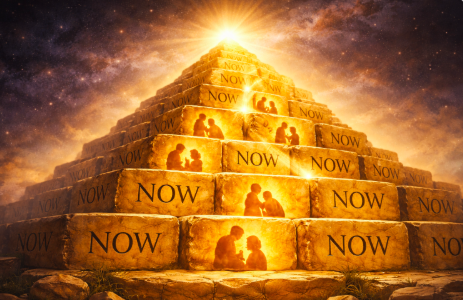
Some may find it helpful to picture the block not as a flat, impersonal slab, but as something more architectural — like an ancient pyramid built of every event in a life. Each stone is a real moment, eternally fixed. The whole structure stands complete. Yet attention moves like light within it: usually sideways across adjacent stones, but occasionally — through insight, love, forgiveness, or grace — upward, toward a brighter apex where the structure feels suffused with meaning, with something that transcends the geometry itself. The physics stops at four dimensions; the spirit, perhaps, adds its own vertical axis of depth and radiance. Whether literal or poetic, the image reminds us: we are not trapped in a single stone. We are the pyramid — and it is lit from within.
For a broader perspective on the question of Time, see the chapter 9.24:
“Viewing Time through Perception Spheres”